Dynasty Fantasy Football Trade Tips: Steal Value & Win Deals 2026
Trading is the lifeblood of dynasty fantasy football, and mastering it is the single most valuable skill a dynasty manager can develop. In redraft leagues, the waiver wire is where championships are often won, but in dynasty, the trade market is the main engine of roster building. These dynasty fantasy football trade tips will teach you how player value really works, when to buy and sell, how contenders and rebuilders should approach deals differently, how to negotiate so your offers actually get accepted, and which mistakes quietly sink most franchises. You keep your players year after year, which means every trade shapes your team not just for this season, but for the next three to five seasons. A single great trade can open a multi-year championship window. A single bad one can bury your franchise for just as long.
Here is the mindset shift that separates good dynasty traders from everyone else: it is not about tricking your league mates or “winning” every deal on paper. The best dynasty traders build a reputation for fairness, understand value better than their opponents, and know exactly when to strike. They also understand that dynasty trading is a year-round game. While redraft managers go quiet from February to August, sharp dynasty managers are working the phones (so to speak) all offseason, because that is when the best values appear. Whether you are entering your first dynasty season in 2026 or you are a veteran looking to sharpen your edge, this guide gives you a complete, practical system for trading smarter.
Why Trading Matters More in Dynasty Than in Redraft
In a redraft league, every team starts fresh each year. If you make a bad trade in October, the damage ends in January. Dynasty does not give you that reset button. Your roster carries over, so a trade’s consequences compound over time. Trade away a 23-year-old rising star for a 30-year-old veteran having a career year, and you might win this season but lose the next four. That compounding effect is exactly why these dynasty fantasy football trade tips matter so much: small edges in valuation, repeated over years, become enormous advantages.
Trading also matters more because the player pool is thinner. In redraft, you can stream quarterbacks or find breakout running backs on the waiver wire. In dynasty, every meaningful asset is already rostered. The waiver wire is mostly undrafted rookies and deep bench stashes. If you want to improve your starting lineup, you almost always have to trade for it. That makes the trade market the true free agency of dynasty leagues, and the managers who work it hardest usually build the strongest teams.
Finally, dynasty leagues simply have more kinds of trades. You are not just swapping players for this season’s production. You are trading age curves, contention windows, rookie draft picks one to three years out, and even roster spots. A rebuilding team might trade its best veteran for two first-round picks, while a contender does the exact opposite. Both sides can win, because they are optimizing for different timelines. Understanding your own timeline is the foundation of every good dynasty trade, and it is the first thing we will nail down in this guide.
Understanding Player Value: The Three Pillars
Every dynasty asset’s value rests on three pillars: age, production, and situation. Age determines how many productive seasons a player likely has left. Production tells you what the player is right now. Situation, meaning the team, offense, and coaching around him, tells you whether that production is likely to grow, hold steady, or decline. When you evaluate any trade, you are really asking how these three pillars stack up on each side of the deal.
- Age: how many productive seasons remain. Youth is currency in dynasty. A 24-year-old and a 29-year-old might score the same points this year, but the younger player is worth far more because of the extra seasons ahead of him.
- Production: what the player scores now, and how he earns it. Targets, snap share, air yards, and red zone usage predict future scoring far better than last year’s fantasy finish or touchdown total.
- Situation: team, offense, and coaching. The fastest-moving pillar and the source of the best buy-low windows. A coaching change or a trade to a better offense can transform a player’s value overnight.
Age is the pillar that redraft converts underestimate most. As a rule of thumb, running backs peak earliest and decline fastest, often around age 27 or 28. Wide receivers peak around 26 to 29 and tend to age gracefully. Tight ends develop slowly but can produce into their early 30s. Quarterbacks in superflex leagues hold value the longest, sometimes well into their mid-30s. We will break these age curves down position by position later in this guide, because getting age right is one of the highest-leverage dynasty fantasy football trade tips there is.
Production deserves a closer look than most managers give it. Raw fantasy points do not tell the whole story. Look at how a player earns his points. A receiver who commands 150 targets is a far safer bet than one who scored the same total on 90 targets with unsustainable touchdown luck. Touchdowns are volatile year to year; targets, routes run, and snap share are sticky. When you are deciding whether to buy a slumping player or sell a surging one, always check the underlying usage first. If the process is intact, the results usually follow. If the process is shaky, the results are probably a mirage.
Situation is the trickiest pillar because it changes the fastest. A player traded to a better offense, a new coaching staff that finally uses him correctly, or an injury to the starter ahead of him can transform his value in a single week. Smart dynasty traders monitor coaching hires, free agency moves, and depth chart battles constantly, because situation shifts create the best buy-low and sell-high windows of the entire season. Set up news alerts for your trade targets during the offseason. The manager who hears about a coaching change first often gets the best price.
The Golden Rules of Dynasty Fantasy Football Trade Tips
Before you send a single offer, internalize these rules. They will save you from the vast majority of bad trades, and they form the backbone of every piece of advice that follows in this guide.
- Rule 1: Always know your window. Are you contending this year, rebuilding, or stuck in the middle? Every trade should move you toward your window. Contenders trade future picks for veterans. Rebuilders trade veterans for picks and young players. The worst place to be is the middle, where you are not good enough to win and not bad enough to earn premium draft picks.
- Rule 2: Trade from strength to address weakness. If you have four startable running backs and one good receiver, you do not need a fifth running back. Package one with something else to upgrade your weakest starting spot. Championships are won by eliminating lineup holes, not by collecting depth.
- Rule 3: Value is not the same as price. A popular trade calculator might say two players are equal in value, but the actual price depends on your league. If nobody will pay full price for your aging star, his market price is lower than his theoretical value. Trade at market prices, not spreadsheet prices.
- Rule 4: Never make a trade you cannot explain. If you cannot state in one sentence why a trade helps your team, do not make it. “I am getting younger at receiver while staying competitive” is a reason. “The calculator said I win by 200 points” is not.
- Rule 5: The best trade is one both sides like. Managers who feel ripped off stop trading with you. Managers who feel they got a fair deal come back for more. Over a multi-year league, a reputation for fairness is worth more than any single lopsided win.
Rule 5 deserves emphasis because beginners almost always get it backwards. They chase the “trade rape” screenshot, the deal so lopsided it becomes league legend. But dynasty leagues last for years, and trade partners have long memories. One predatory deal can close doors for three seasons. Meanwhile, the manager known for fair, thoughtful offers becomes everyone’s first call when they decide to shop a player, which means they see the best deals first. Play the long game with your reputation the same way you play the long game with your roster.
How to Value Draft Picks in a Dynasty Trade
Rookie draft picks are the currency of dynasty trading, and mispricing them is the most common mistake managers make. Get pick valuation right and half of your trades will take care of themselves. Here is how to think about picks correctly.
First, not all picks are equal. In a typical 12-team league, the 1.01 rookie pick is worth dramatically more than the 1.12. Early first-round picks have a genuine shot at landing an instant fantasy starter, sometimes a franchise cornerstone you roster for a decade. Late first-round picks are lottery tickets with real bust rates. Whenever someone offers you “a first-round pick,” always ask which one. A projected early first from a weak team can be worth twice as much as a projected late first from the league favorite. Vague pick offers are where value goes to die, so pin down the likely range before you evaluate anything.
Second, future picks are worth less than current-year picks. A 2027 first-round pick is less valuable than a 2026 first for two reasons: you have to wait a year to use it, and you cannot know how good the pick will be because you do not know where that team will finish. As a rough guide, discount future picks by about one round per year out. A 2027 first is roughly worth a 2026 second, and a 2028 first is roughly worth a 2026 third. Adjust based on how predictable the team is: a first from a perennial contender is safer than one from a chaotic middle-of-the-pack team, so it deserves a smaller discount.
| Pick | Relative Value | What It Means in a Trade |
|---|---|---|
| Projected early 2026 1st | 100 (baseline) | Premium asset; can headline a deal for a young star |
| Projected mid 2026 1st | 70-80 | Solid centerpiece; needs a sweetener for elite talent |
| Projected late 2026 1st | 50-60 | Lottery ticket; worth about half an early first |
| 2027 1st | Roughly a 2026 2nd | Discount about one round per year into the future |
| 2028 1st | Roughly a 2026 3rd | Two rounds of discount; high uncertainty |
| 2nd rounders | Role-player prices | Best used as sweeteners, not headliners |
| 3rd rounders and later | Throw-in value | Useful for tipping a close deal, not anchoring one |
Third, pick value moves with the calendar. Rookie picks are cheapest in the middle of the NFL season, when the draft feels far away and everyone is focused on weekly lineups. They are most expensive from April through August, when rookie fever peaks and everyone has watched the highlight reels. If you are a rebuilder collecting picks, buy them in-season when nobody is thinking about them. If you are cashing out picks for veterans, wait until draft season when their value peaks. This seasonal rhythm is one of the most reliable market inefficiencies in dynasty, and patient managers exploit it every single year.
Finally, remember that picks are uncertain by nature. Even the 1.01 busts sometimes, and late firsts miss more often than they hit. When you trade a proven young player for picks, you are trading certainty for upside, so make sure the package is big enough to justify that risk. One first-round pick for a proven 24-year-old starter is usually not enough. Two firsts, or a first plus a promising young player, is closer to fair. And when you check values against a dynasty player value chart, remember that the chart shows consensus value while your league’s market sets the actual price. Use the chart as your compass, not your autopilot.
The Dynasty Trade Value Calendar: When Picks Peak and Dip
One of the most underrated dynasty fantasy football trade tips is also one of the simplest: trade the same asset at different times of year and you will get very different prices. The dynasty market has a predictable seasonal rhythm, and learning it lets you buy low and sell high almost on schedule.
- September to November: the buy-low season. Rookie picks are at their cheapest because the draft feels distant. Slumping veterans are available at discounts. This is when rebuilders should be acquiring future picks and patient managers should be buying struggling young players.
- December: the deadline frenzy. Contenders overpay for the final pieces of a championship run. If you are selling veterans, this is your Super Bowl. Prices for win-now production peak in the two weeks before your league’s trade deadline.
- January to March: the calm rational market. After the season ends, values settle. This is the best time for big-picture rebuilding trades, because nobody is emotional about last week’s box score anymore. Young players who disappointed as rookies are often available at steep discounts in February.
- April to August: rookie fever. The NFL Draft, training camp hype, and preseason highlights push rookie pick values to their yearly peak. This is when you sell picks if you are contending, and when you absolutely should not be buying them at retail price.
The practical takeaway is to always ask yourself which season you are in before proposing a deal. Selling a 2026 first in October is leaving money on the table; selling it in June captures peak value. Buying a struggling second-year player in November gets you a discount; buying him in August means paying full hype price. Put the calendar on your side and you will win trades before negotiations even start.
Buy Low and Sell High: Timing the Market
The single most profitable skill in dynasty trading is timing. Player values swing wildly through the year based on recency bias, and disciplined managers exploit those swings relentlessly. The concept is simple; the discipline is hard.
- Buy-low windows: a slow start with targets, snaps, and routes still intact; a minor injury suppressing the price; offseason discounts on rookie-year disappointments; quarterback or coaching noise that has nothing to do with the player’s talent.
- Sell-high windows: a veteran aged 29 or 30 having a career year; a touchdown-dependent spike game; a backup filling in for an injured star; hype exploding after one big nationally televised performance.
The key to buying low is distinguishing a slump from a real decline. Check the underlying usage before you buy. If the targets, snap share, and routes run are still there, the production will usually follow, and you are buying a temporary discount on a permanent asset. If the usage has collapsed, if the player is losing snaps to a younger teammate, or if the role itself has changed, you are not buying low. You are catching a falling knife. Always verify the process before you pay for the name.
Selling high requires emotional discipline, because it means trading away players at the exact moment they feel most valuable. The classic sell-high is the veteran having a career year at age 29 or 30. His value will never be higher, and his decline is coming whether you acknowledge it or not. A practical example: imagine a 28-year-old running back who just rushed for 180 yards and three touchdowns on national television. Contenders will overpay for him that week. If you are not a strong contender, that is the moment to sell, because in six weeks nobody will remember that game and his age-related decline will be the story again.
One more timing nuance: the best buy-low offers often look like overpays in the moment. Offering a first-round pick for a struggling second-year receiver in November feels aggressive. By the following September, when he breaks out, it looks like theft. Dynasty rewards managers who trust process over box scores, and the trade market is where that patience gets priced in.
Age Curves by Position: The Dynasty Fantasy Football Trade Tips Cheat Sheet
Age is the variable that separates dynasty trading from every other fantasy format, so it deserves its own deep dive. Every position has a different aging curve, and misreading these curves is how managers end up trading premium picks for players with one good season left. Memorize these patterns and you will instantly evaluate trades faster than most of your league mates.
| Position | Typical Prime | Age Cliff Warning | Trading Implication |
|---|---|---|---|
| Running back | Ages 22-27 | Sharp decline often starts at 28 | Sell RBs at 27; never pay premium picks for a 28-plus RB unless contending |
| Wide receiver | Ages 24-29 | Gradual decline after 30 | WRs are the safest veteran buys; elite 28-year-olds still hold strong value |
| Tight end | Ages 25-31 | Slow developers, slow decliners | Be patient with young TEs; veterans remain startable into their early 30s |
| Quarterback (superflex) | Ages 25-34 | Latest cliff of any position | Elite QBs are decade-long assets; pay up for youth and talent confidently |
| Quarterback (1QB) | Ages 26-33 | Replaceable via draft/streaming | Do not overpay; positional value is much lower than in superflex |
Running backs deserve special caution because their cliff is the steepest. The data is brutal and consistent: backs with heavy workloads start breaking down around age 28, and the fall is sudden, not gradual. A 27-year-old workhorse back is a depreciating asset every single week you hold him on a non-contending team. That does not mean you can never roster an older back. It means you should only pay for one when you are genuinely contending, and you should be actively shopping yours the moment your season slips away.
Wide receivers are the opposite: the safest position to invest in. Elite receivers routinely produce into age 30 and beyond, which means a 28-year-old receiver with a strong target profile is still a premium dynasty asset, not a sell-now candidate. This is why rebuilding teams should prioritize acquiring young and prime-age receivers above all else. They hold value the longest, they are the easiest assets to eventually flip to contenders, and they form the backbone of multi-year contention windows. When in doubt about where to park long-term value, park it at wide receiver.
The Age Cliff Rule of Thumb
Before acquiring any veteran, ask: how many elite seasons does he realistically have left? For running backs over 27, the answer is shrinking fast, so only pay up as a contender. For receivers under 29 and tight ends under 31, elite production often continues for years. Match the player’s remaining prime to your contention window, and never trade long-term assets for short-term production unless a championship is genuinely within reach this season.
Trading as a Contender: Going All In the Right Way
If your team is one or two pieces away from a championship, your job is simple: convert future value into present production. Trade draft picks and young bench players for proven veterans who score points right now. But going all in does not mean being reckless. The difference between a smart contender and a desperate one is selectivity.
Target veterans with stable production rather than boom-or-bust names. A 30-year-old receiver who has finished as a top-15 option three years running is a better trade target than a 26-year-old with one great season and two quiet ones. You are buying certainty for a title run, not lottery tickets. Look for players with locked-in roles, strong target shares, and offenses that support fantasy scoring. Boring and reliable beats exciting and volatile when a championship is on the line.
- Target stable producers with multi-year track records, not one-year wonders riding touchdown luck.
- Trade picks aggressively, but keep at least one future first-round pick in reserve so you can reload.
- Never trade a first-round pick more than two years out unless you are getting a young star (25 or under) in return.
- Deal with rebuilding teams: offer them youth and picks, not your own aging veterans they do not want.
- Strike early in the season, before trade deadline prices peak and bidding wars start.
- Fix your weakest starting spot first; one lineup hole costs more championships than any other single factor.
Also, shop in the right places. Rebuilding teams are your natural trade partners. They want your picks and young players; you want their veterans. Send offers that give them what they actually want and you will find deals come together fast. And do not wait until the trade deadline when prices peak and every other contender is bidding on the same players. The best contender trades happen early in the season, before everyone realizes which veterans are available. A deal made in week 4 at a fair price beats the same deal made in week 11 at a 30 percent premium, and you get seven extra weeks of production from the player.
Trading as a Rebuilder: Collecting Future Value
Rebuilding is about converting present production into future value. Your veterans are depreciating assets. Every week you hold a 29-year-old star on a 3-7 team, he gets older and his trade value drops. Your job is to sell veterans at peak value and accumulate picks and players under 25 who will form your next contention core.
Start by identifying which veterans to move. Anyone over 27 who is not part of your next contention window should be shopped actively. Do not get sentimental. That player who won you a title three years ago is not winning you one now, and his value only goes down from here. The hardest part of rebuilding is accepting that your favorite players are trade chips. The managers who rebuild fastest are the ones who sell a year too early rather than a year too late.
- Shop every veteran over 27 who is not in your next contention window, and shop them early.
- Demand first-round picks and under-25 talent, not packages of mediocre depth pieces.
- One early first-round pick beats three third-round picks: quality over quantity, always.
- Sell at the trade deadline when contenders get desperate and bidding wars erupt.
- Use open roster spots to absorb bad contracts or injured players when a draft pick is attached.
- Convert some picks into young proven players; do not just hoard six firsts and draft six lottery tickets.
Timing matters for sellers too. Do not wait until the offseason to shop veterans, when contenders have stopped thinking about this season and prices go quiet. The trade deadline is your Super Bowl. Contenders get desperate in the final weeks before the deadline and will pay real premiums for the last impact veterans available. Start conversations early, let bidding develop between two or three interested contenders, and sell to the highest bidder. Nothing raises a veteran’s price like two contenders who both believe he is the missing piece.
Escaping the Middle: Dynasty Fantasy Football Trade Tips for Stuck Teams
The most dangerous place in dynasty is the middle: too good to earn premium rookie picks, too bad to win a championship. Middle teams finish 6-7 or 7-6 every year, draft in the middle of every round, and slowly watch their veterans age out without ever contending or rebuilding. If that sounds like your team, you need to make a decision, because staying in the middle is the only truly wrong answer.
To decide which direction to go, run an honest audit. List your top eight players with their ages. If you have at least five legitimate difference-makers aged 27 or under, you may be one aggressive offseason away from contending: consider trading future picks for the veterans who complete your lineup. If your best players are mostly 28-plus and your young talent is thin, you are a rebuilder in denial. The longer you wait to accept it, the less your veterans will fetch. Rip the bandage off, sell at the deadline, and start collecting the picks and youth that become your next core.
The Middle-Team Test
Ask yourself two questions. First: if everything breaks right, can this roster win the championship this year? Second: if I sold my three best veterans today, would the return jump-start a real rebuild? If the answer to the first is no and the second is yes, you are a rebuilder. Commit fully. Half-measures, like selling one veteran while keeping the rest, just keep you stuck in the middle for another season.
How to Negotiate Trades That Actually Get Accepted
Knowing values is only half the battle. The other half is negotiation, and most dynasty managers are bad at it. Here is a practical system for getting more of your deals done without burning relationships.
Start with conversation, not an offer. The worst approach is firing off a cold offer with no context. Instead, send a message first: “Hey, I like your running back depth. Are you open to moving one of them? I have receiver depth to deal from.” This opens a dialogue and tells you what the other manager actually wants before you guess wrong with a formal offer. Ten minutes of conversation routinely saves days of rejected offers.
Make your first offer fair, not insulting. Lowball offers do not start negotiations; they end them. Many managers will not counter an insulting offer out of principle, and some will remember it for seasons. Your first offer should be in the ballpark of fair, maybe slightly in your favor. That gives the other side room to counter without feeling disrespected, which is exactly the dynamic you want.
- Do: start with conversation, make the first offer fair, tailor every offer to their actual roster needs, and explain the fit explicitly.
- Do: give something real to get something real. If you want a star, you have to feel some pain, and do not fear overpaying slightly for the perfect fit.
- Do: keep deals simple. Two-for-two and three-for-three packages get accepted far more often than five-player blockbusters.
- Do not: send lowball offers that end talks before they start, or argue when someone says no. Ask what it would take instead.
- Do not: propose a trade that ignores the other manager’s needs, like offering a fourth quarterback to a team desperate for a running back.
- Do not: disappear for days mid-negotiation or spam a counter every hour. One thoughtful message per day is the right cadence.
Give to get, and make it easy to say yes. Offers where you give up nothing of real value get rejected instantly. Include at least one piece the other manager genuinely wants, and do not be afraid to overpay slightly for the perfect fit. If a player completes your starting lineup for a title run, paying 10 percent above market value is smart, not wasteful. Also consider the other manager’s roster construction in every offer, and say so explicitly: “This gives you a starting running back, which I know you need.” People accept trades faster when they can see you thought about their team, not just yours.
The best trade is one both sides like. Managers who feel ripped off stop trading with you. Managers who feel they got a fair deal come back for more, and in a league that lasts for years, repeat partners are worth more than any single lopsided win.
Using Trade Calculators and Value Charts the Right Way
Popular trade calculators and dynasty value charts are useful tools, but most managers use them wrong. They treat the numbers as gospel, argue over 50-point differences, and forget that a calculator cannot see your league. Here is how to use these tools the way sharp managers do.
First, use calculators as a starting point, not a verdict. They are excellent for sanity-checking whether a deal is roughly balanced. If a tool says you are losing by 40 percent, you probably are, and you need a strong justification like a perfect positional fit to proceed. But if the tool says a deal is within 10 percent either way, that is effectively even. Arguing over tiny gaps misses the point: calculators measure consensus value, while your league’s actual market sets the price.
Second, understand what calculators get wrong. They are slow to react to breaking news, they struggle with league-specific scoring like tight end premium or superflex, and they cannot price in your contention window. A 30-year-old star might grade as fairly valued on a chart while being nearly worthless to your rebuilding roster. Always apply your own context after the calculator gives you its baseline. Cross-check values against a current dynasty rankings list to see how the market views each player’s tier, then adjust for age, your window, and your league’s scoring.
Third, never cite a calculator in negotiations. “The calculator says you win this trade” is the fastest way to make someone defensive, because nobody likes being told a spreadsheet knows their team better than they do. Keep the numbers to yourself, use them to build fair offers, and negotiate on football logic: fit, need, age, and timeline. The calculator is your private advisor, not your opening argument.
Positional Scarcity: Why Quarterbacks, Tight Ends, and Running Backs Price Differently
Not all positions are created equal in trade value, and your league’s scoring settings change the math dramatically. Understanding positional scarcity is one of the most practical dynasty fantasy football trade tips, because it tells you which positions to pay up for and which to fill cheaply.
In superflex leagues, where you can start two quarterbacks, elite QBs are the most valuable assets in dynasty. There are only so many franchise quarterbacks, every team needs two, and the good ones produce for a decade or more. A top-five dynasty quarterback is worth more than almost any non-quarterback. In 1QB leagues, the math flips completely: quarterback is deep and replaceable, so never pay premium prices for one. Know your format before you value the position.
Tight end premium scoring creates a similar distortion. In standard scoring, only three or four tight ends are true difference-makers, so the elite ones carry a massive positional advantage. In tight end premium leagues, where tight ends get extra points per reception, that advantage grows even larger. A young elite tight end in a premium league is a genuine cornerstone asset. In leagues without the premium, tight end is a replaceable streaming spot and you should not pay up for it.
Running backs are the trickiest position to price because they combine high weekly impact with the shortest shelf life. A workhorse back can single-handedly win you weeks, which makes contenders pay up. But the age cliff means you should almost never build around backs long-term. The sharp approach: acquire running back production when you are contending, rent it for the title run, and sell before the cliff. Rebuilders should treat running backs as the last piece they add, not the first, because a great young back on a bad team just gets older while you lose.
The Art of the Multi-Player Deal: 2-for-1s, 3-for-2s, and Package Trades
Most dynasty trades are not one-for-one swaps. They are packages, and understanding package dynamics unlocks deals that straight swaps never could. The core concept is consolidation: two good players are usually worth less in trade than one great player, because fantasy lineups have limited starting spots. A team would rather start one elite receiver than two flex-level ones.
The 2-for-1 is the most common consolidation trade. You package two solid starters for one star. The team receiving the star upgrades their lineup’s ceiling. The team receiving the two players gains depth. Crucially, the team giving up two players frees a roster spot, which has hidden value in dynasty because it opens room for a developmental stash. When you propose a 2-for-1, you generally need to overpay slightly on raw value, because you are asking the other manager to give up the best player in the deal.
The reverse move, the 1-for-2, is a classic rebuilder play. You trade one veteran star for two younger assets: maybe a first-round pick and a 23-year-old with upside. You are diversifying, spreading one asset’s value across two lottery tickets and picks that fit your timeline. Just remember the quality rule: one early first beats a pile of thirds. A 1-for-2 where both pieces are mediocre is not diversification. It is just getting worse.
A practical rule for all package deals: the team getting the best player usually needs to add a small premium, roughly 10 to 15 percent above even value, because elite talent is harder to replace than depth. And always do the roster math. In a 3-for-2, someone has to cut a player. In a 2-for-1, someone gains a stash spot. Factor that hidden value into your evaluation, and mention it in negotiations, because it is a genuine benefit the other manager might not have considered.
How to Evaluate Any Trade Offer in 5 Minutes
When an offer lands in your inbox, run through this checklist before responding. Five minutes of structured evaluation prevents more bad trades than any calculator ever will.
- Step 1: Check your window. Does this trade move you toward contention or toward a rebuild, whichever you have chosen? If it does neither, decline. No further analysis needed.
- Step 2: Compare ages and timelines. List the key pieces on each side with their ages. Are you getting younger or older? Does that match your plan? A contender getting older is fine. A rebuilder getting older is a red flag.
- Step 3: Sanity-check with a value chart. Use a dynasty trade value chart to see if the deal is roughly balanced. Do not treat the numbers as gospel, but if the tool says you are losing by 40 percent, you probably are. Big gaps need real justification.
- Step 4: Consider the picks honestly. If picks are involved, project where they will actually land. A first from the worst team in the league is gold. A first from the champion is a late dart throw. Adjust the deal’s balance accordingly.
- Step 5: Sleep on big deals. For any trade involving a first-round pick or a top-20 player, wait at least a few hours before accepting. Excitement causes more bad trades than bad evaluations. If the deal still looks good in the morning, accept it then.
Step 5 is the one managers skip most often, and it costs them the most. Trade offers create urgency artificially. The other manager wants an answer now, your league chat is buzzing, and the player you are acquiring just had a big week. That emotional cocktail is exactly when mistakes happen. Build a personal rule: no same-day acceptance on franchise-altering deals. The good offers will still be there tomorrow. The bad ones are the ones you regret at midnight.
Trading During the NFL Draft and Rookie Draft Season
April through August is the most trade-active stretch of the dynasty calendar, and it rewards managers who prepare. The NFL Draft in April resets rookie values overnight: landing spots, draft capital, and depth chart opportunity turn college prospects into dynasty assets with real price tags. Then your league’s rookie draft, usually in May or June, puts those picks into play.

If you hold early rookie picks during this window, you are holding peak-value assets. Everyone has watched the highlights, every podcast is hyping the class, and rookie fever is at its height. This is the time to sell picks if you are contending: convert that fever into proven veterans at the best exchange rate of the year. If you are rebuilding, this is generally the time to hold your picks or even buy more only if the price is reasonable, because you want to draft the talent yourself rather than pay the hype premium.
The days immediately after the NFL Draft are especially volatile. A receiver drafted in the first round by a pass-happy offense sees his dynasty value jump overnight. A running back who lands behind an entrenched starter sees his dip. Managers who have done their rookie homework, studying the incoming class on a current rookie rankings board before the draft, can strike in the 48 hours after the draft while slower league mates are still catching up. Speed plus preparation is a genuine edge in this window.
One more draft-season tactic: trade back in rookie drafts. If you hold the 1.04 and your tier of prospects runs four deep, moving back to 1.07 while picking up an extra second-rounder is often the sharpest move on the board. You still get a player from your tier, plus a free lottery ticket. Managers who fall in love with “their guy” at a specific slot leave this value on the table every year.
In-Season Trading: Weekly Windows and the Trade Deadline
Once the season kicks off, the trade market moves week to week on performance, injuries, and standings. The managers who trade best in-season are the ones who act on information quickly while everyone else is still reacting emotionally to Sunday’s box scores.
Early in the season, weeks 2 through 5, be a buyer of struggling talent. This is when panic sets in for other managers. A star receiver with 12 targets and no touchdowns through three weeks is a buy-low screaming for attention. The underlying usage says the breakout is coming; the box scores say otherwise. Patient buyers acquire these players at discounts that disappear by midseason. Conversely, be cautious about buying players coming off one massive week. One game does not change a player’s talent, and you will pay full hype price for it.
As the trade deadline approaches, the market splits in two. Contenders become buyers with urgency, and rebuilders become sellers with leverage. If you are a contender, do not wait until deadline week: start your shopping two or three weeks early, when prices are still sane and you get extra weeks of production from anyone you acquire. If you are a rebuilder, let the deadline come to you. Create the impression of multiple suitors, set a clear asking price, and let desperate contenders bid against each other. The final 72 hours before the deadline routinely produce the year’s biggest overpays.
Injuries create the sharpest in-season windows of all. When a starter goes down, his backup’s value spikes instantly, and the starter’s dynasty value often dips on short-term pessimism. Both moves are usually overreactions. The backup is rarely as good as two good games suggest. The injured star is rarely as damaged as the market fears, especially with soft-tissue injuries that heal cleanly. Trade with the long view while everyone else trades the headline.
Offseason Trading: The Quiet Months Where Dynasties Are Built
From January through March, most fantasy managers go quiet. The season is over, the highlights have faded, and nobody is setting lineups. This silence is exactly why the offseason is where the best dynasty traders do their finest work. Values are calm and rational, nobody is emotional about last week’s box score, and patient managers can acquire talent at prices that would be unthinkable in September.
The single best offseason tactic is buying rookie-year disappointments. Every year, highly drafted rookies underwhelm, and every February their managers are frustrated and ready to move on at a discount. But rookie production is notoriously unpredictable: many of the game’s best dynasty assets were quiet as rookies. A second-year receiver with elite draft capital, strong athletic testing, and a full offseason in an NFL program is one of the highest-upside buys in all of dynasty. You are paying February prices for September potential.
Coaching changes are the other great offseason catalyst. When a new head coach or offensive coordinator arrives, depth charts and schemes get reshuffled. Players who were misused under the old staff suddenly have paths to bigger roles. The managers who track coaching hires in January and act before the market adjusts in March consistently find value. Follow beat reporters for teams with new staffs, and check NFL news regularly through the hiring cycle so you hear about scheme fits before your league mates do.
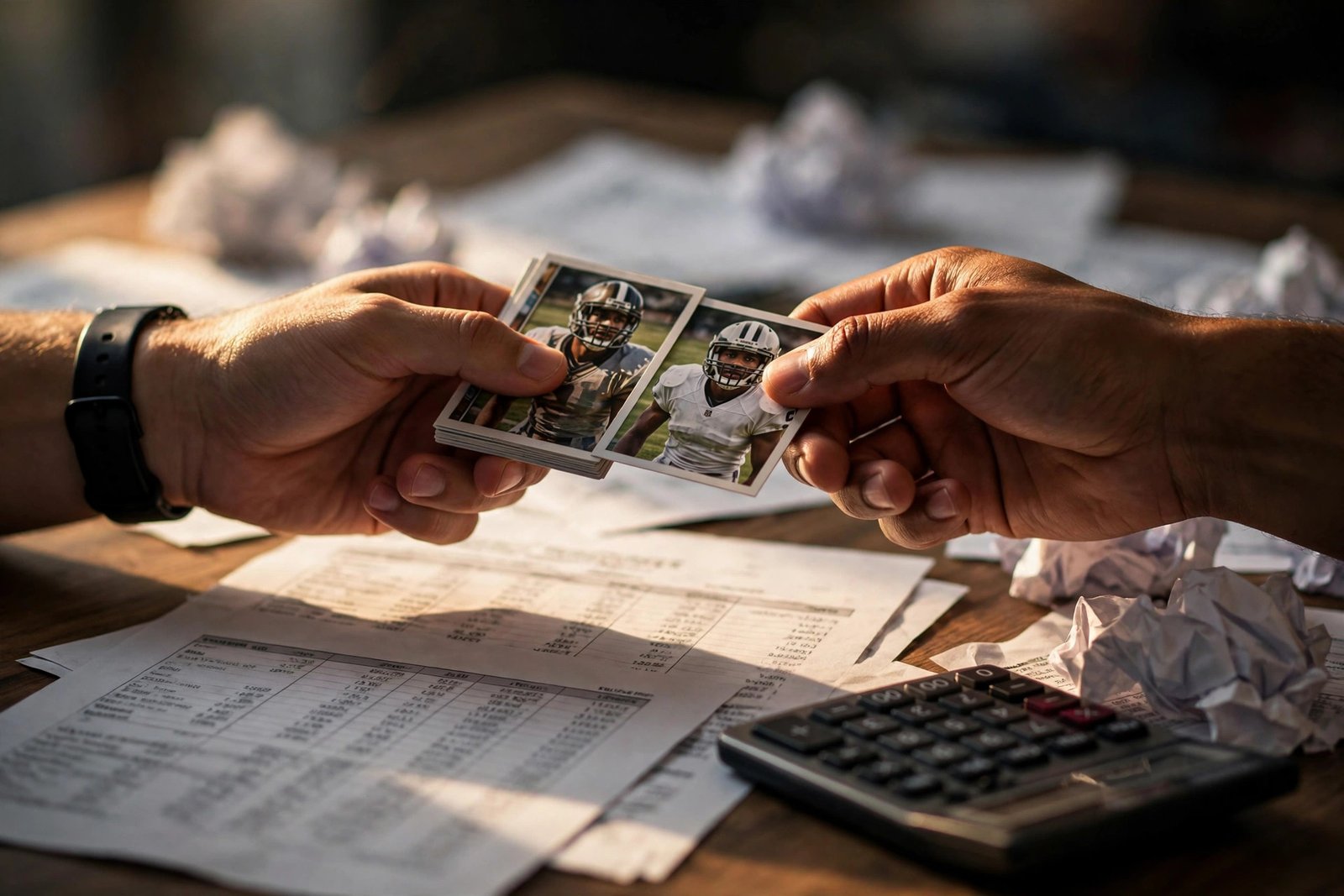
Finally, use the offseason for your franchise’s big-picture moves. This is the time to execute the rebuilder’s teardown or the contender’s final upgrades, because you can think clearly without weekly scoreboard pressure. Map your roster’s age profile, identify your contention window honestly, and make the two or three franchise-defining trades your plan requires. Then let the season come to you. The managers who do their heaviest trading in February and March spend September through December watching their plan work.
Common Dynasty Trade Mistakes to Avoid
Even managers who understand value make these mistakes. Run through this list honestly and fix whichever ones sound familiar, because eliminating errors is just as valuable as finding edges.
- Falling in love with your players. Every manager overvalues their own roster. That third-year breakout candidate you drafted as a rookie feels worth more to you than to anyone else. Acknowledge this bias and mentally discount your own players’ value by about 10 percent when evaluating offers.
- Trading just to trade. Activity is not achievement. Some managers make deals every week because it is fun, churning their roster sideways without improving it. Every trade needs a clear purpose tied to your contention window.
- Ignoring age cliffs. Running backs fall off fast after 27. Trading premium picks for players at the age cliff is how contenders become rebuilders overnight. Always check a player’s age before acquiring him.
- Overvaluing your draft picks. Your 2027 first feels like gold to you, but to a trade partner it is a mystery box. Do not demand proven-star returns for unknown picks, and do not hoard picks forever. Picks are meant to be spent.
- Chasing last week’s box score. Buying a player at peak hype after one massive game is the most expensive way to acquire talent. Always check whether the usage supports the production before you pay for it.
- Veto-baiting and league politics. Do not lobby for vetoes of other people’s deals. Nothing kills a dynasty league faster than trade veto drama. Assume managers have reasons you cannot see rather than assuming collusion.
- Forgetting roster math. In a 2-for-1 you free a roster spot with real stash value. In a 1-for-2 you have to cut someone. Always account for the roster consequences, especially in leagues with short benches.
| Mistake | Why It Hurts | The Fix |
|---|---|---|
| Loving your players | You overvalue your roster by about 10 percent | Discount your own players mentally before evaluating offers |
| Trading just to trade | Activity without purpose churns the roster sideways | Every deal must serve your contention window |
| Ignoring age cliffs | Premium picks spent on declining veterans backfire | Check age and remaining prime before acquiring anyone |
| Overvaluing your picks | Your future first is a mystery box to others | Price picks at market rates; spend them, do not hoard them |
| Chasing box scores | You pay peak hype prices for unsustainable games | Verify usage (targets, snaps) before buying any surge |
| Veto drama | Lobbying destroys league trust faster than any bad trade | Assume hidden reasons; never campaign against deals |
| Forgetting roster math | Hidden costs and benefits go uncounted | Count the roster spot as part of every package deal |
Real Trade Examples: Good Deals and Bad Ones
Concepts stick better with concrete examples. Here are realistic dynasty trades that show these principles in action.
Example 1, a textbook rebuilder trade: a 4-6 team trades its 29-year-old WR1, a proven top-10 receiver, to a 9-1 contender for a projected early 2026 first, a 2027 first, and a 23-year-old receiver showing breakout signs. The contender gets the piece it needs for a title run. The rebuilder gets two premium picks plus youth. Both sides advance their timelines. This is exactly how rebuilding trades should look: quality picks, young talent, and a clear direction.
Example 2, a smart contender overpay: an 8-2 team with a hole at running back trades its 2026 first (projected late), a 2027 second, and a young backup tight end for a 27-year-old workhorse running back. On pure calculator value the contender overpays slightly, but the deal fills its last lineup hole for a championship push, and the picks were unlikely to help this year anyway. The rebuilder adds two picks and a developmental piece. Fair, purposeful, and correctly priced for each team’s window.
The pattern in every good dynasty trade is the same: each side’s timeline is respected, and the return matches the asset’s true worth. The pattern in every bad one is also the same: someone ignored their window or mispriced age and picks.
Example 3, the treadmill of mediocrity: a 5-5 middle-of-the-pack team trades two first-round picks for a 30-year-old running back. The team is not a real contender, so the veteran does not move the needle, and now the franchise has no picks to rebuild with. This is the classic stuck-in-the-middle move: too good to earn premium picks, too bad to win, and now without the currency to escape.
Example 4, the impatient sell: a rebuilder trades a 23-year-old emerging star receiver for a single late first-round pick because they got impatient waiting for the breakout. One late first has roughly a 30 percent hit rate of ever becoming a fantasy-relevant starter. Trading a proven young asset for that kind of lottery ticket, without additional compensation, is giving away value. Patience with young talent is one of the most profitable traits a dynasty manager can develop.
Building a Trade Partner Network: Reputation and Relationships
Here is a truth that no calculator will tell you: the best trade asset you own is your reputation. Dynasty leagues run for years, and trade partners have long memories. The manager known for fair offers, quick responses, and honest communication becomes everyone’s first call when they decide to shop a player. That means they see the best deals first, get the first counter-offers, and hear about availability before it becomes public. Over a five-year league, that information advantage compounds into a massive edge.
Building that reputation takes deliberate habits. Respond to every offer within 24 hours, even if the answer is no. A quick “not interested, but thanks” keeps the door open; silence closes it. Never send an offer you would be embarrassed to defend in the league chat. When you decline, give a one-line reason so the other manager can recalibrate: “I like the player, I just cannot move my 2026 first.” That single sentence often leads to a revised offer that works for both sides.
The Middle-Team Test
Respond to every offer within a day, even to decline politely. Never send insulting lowballs; they close doors for seasons. Explain your declines in one honest sentence so partners can recalibrate. Trade fairly with rebuilding teams when you contend and with contenders when you rebuild. Over multiple seasons, the manager everyone likes trading with sees every good deal first, and that access is worth more than winning any single negotiation.
Also, diversify your trading relationships. Managers who only ever deal with the same two league mates leave value on the table and breed suspicion. Talk trades with everyone, including the quiet managers who rarely initiate. Some of the best deals come from the league mate who never sends offers but will absolutely listen to a thoughtful message. And keep notes: which managers overvalue youth, which ones are impatient, which ones always need running backs. That knowledge is legal, ethical, and enormously useful.
Dynasty Fantasy Football Trade Tips: Your Season-by-Season Action Plan
Let us turn everything in this guide into a concrete plan you can follow through the 2026 season and beyond. Work through these steps in order and you will trade with more structure than 90 percent of dynasty managers.
- January to March: audit your roster honestly and declare your window. Execute big-picture trades while the market is calm. Buy rookie-year disappointments at February discounts and track coaching changes for scheme-fit value.
- April: study the incoming rookie class before the NFL Draft. Position yourself to act in the 48 hours after the draft, when landing spots reset values and slow managers are still catching up.
- May to August: hold or sell rookie picks at peak fever prices if you are contending. Trade back in rookie drafts when your tier runs deep. Finalize your roster before the season starts.
- September to October: buy slumping talent with intact usage in weeks 2 through 5. Sell hype-driven surges. Start contender shopping early if your team is real.
- November to the deadline: contenders strike for the final pieces; rebuilders let desperate buyers bid against each other. This is where championships and rebuilds are both decided.
- Year-round: maintain your reputation, respond within 24 hours, keep trade talks open with every manager, and sanity-check every significant deal against a current value chart before accepting.
Frequently Asked Questions
How do I know if a dynasty trade is fair?
Start with a dynasty trade value chart or a popular trade calculator to get a baseline, then adjust for your league’s reality. Consider player ages, realistic pick projections, positional needs on both sides, and whether each team’s contention window is respected. A fair trade is one where both teams move meaningfully closer to their goals, even if the raw values are not perfectly equal. If the baseline says you are losing by more than 25 to 30 percent, you need a strong justification, like filling your last starting lineup hole for a title run, before you accept.
Should I trade away my first-round rookie picks?
It depends entirely on your window. Contenders should absolutely trade first-round picks for proven veterans who help win now, because picks do not score points this season. Rebuilders should generally keep early firsts but can trade late firsts for young proven players who fit their timeline. Never trade a first-round pick more than two years out unless you are getting a young star back, and always pin down whether a pick projects early or late before you value it.
When is the best time to make trades in dynasty?
Every season has its window. The trade deadline is peak season for win-now deals, when desperate contenders overpay. Draft season, from April through August, is when rookie picks carry maximum value. The best buy-low window is early in the season, weeks 2 through 5, when slumping players with intact usage are cheapest. And the offseason, January through March, is ideal for calm, rational rebuilding moves. Match your trade type to the calendar and you will consistently get better prices.
How many players should I include in a trade offer?
Keep it simple. Two-for-two and three-for-three deals get accepted far more often than five-player blockbusters, because every added piece is another thing for the other manager to evaluate and dislike. Only add pieces that serve a clear purpose. And always remember roster math: in a 2-for-1, you gain a roster spot with real developmental value; in a 1-for-2, someone has to make a cut. Mention that hidden value explicitly in your negotiation.
Is it better to trade for proven veterans or young upside players?
Match the asset to your window. Contenders want proven veterans with stable, multi-year production, even if they are older. Rebuilders want players under 25 with breakout potential, even if they are unproven. The classic mistake is mixing these up: rebuilders buying 30-year-olds who will decline before the team is ready, or contenders hoarding developmental prospects who will not help this year. Before acquiring anyone, ask which window he serves.
What should I do if nobody in my league wants to trade?
First, audit your reputation honestly. If your offers are consistently lopsided in your favor, people stop engaging, and no tactic fixes that except fairer offers. Start trade talks with conversation instead of cold offers, and make your first offers genuinely reasonable. Trade with rebuilding teams when you are contending and vice versa, because your timelines naturally align. Check your league’s trade activity on platforms like Sleeper to see who has been active historically, and approach the managers who have shown they like to deal. In truly inactive leagues, a commissioner nudge toward activity helps, but you cannot force it.
How do devy players factor into dynasty trades?
Devy leagues, where you roster college players before they enter the NFL, add a whole extra layer to trading. Devy picks and players are even more uncertain than rookie picks, so they trade at steeper discounts, but hitting on a future star two years before his rookie draft is enormously valuable. If your league uses devy rosters, study the devy rankings the same way you study rookie rankings, and treat devy assets as high-upside lottery tickets: great sweeteners in larger deals, but never the headliner you build a trade around.
Conclusion
Dynasty trading rewards the managers who combine clear thinking with good timing and strong relationships. Know your contention window and let it guide every decision. Price age honestly, because age curves are the engine of dynasty value. Buy picks in-season and sell them during draft fever. Buy slumps with intact usage, sell hype before it fades, and never let one exciting box score override months of evidence. Negotiate like someone who wants to trade with these same people for years, because you do.
The managers who win dynasty leagues are rarely the ones who “win” individual trades by the largest margin. They are the ones who make the most good decisions over time: selling a year too early instead of a year too late, staying patient with young talent, escaping the middle decisively, and keeping every trade partner happy enough to deal again. Apply these dynasty fantasy football trade tips through the full season calendar, sanity-check your biggest deals with the dynasty trade calculator before you accept, and your franchise will be better positioned than the vast majority of teams you compete against. Now go work the trade market: your championship window is built one smart deal at a time.
Calculate your dynasty trade values now
Set your league format, add players and picks to both sides, and get an instant trade grade — free, no sign-up needed.
Calculate now for free